Prime Now Available on Freeview Satellite And Freeview HD platforms | infonews.co.nz New Zealand's local news community
Shared via AddThis
Saturday, August 15, 2009

Trade Me content and Seek ad
Amusing observation:
I am not sure if this Seek ad on a trade me press release was part of our ad agency market place ads or a run of network, but it is a nice little laugh to see all a seek ad right next to the article. Stands out like a dogs balls.
I see these sorts of ad/content conflicts every week and often find amusement in them.

Job market tanks but outlook improves - Trade Me
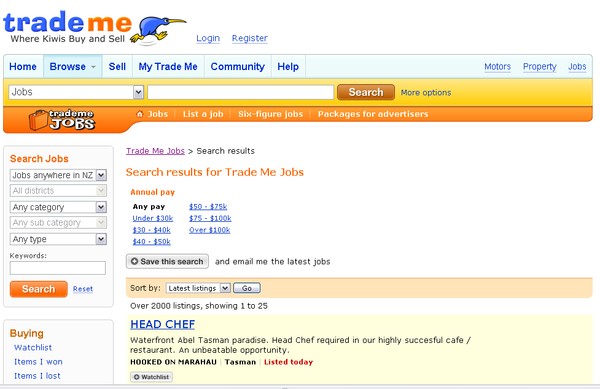
Trade Me Jobs have come out with another release about the job market, this time how the market has tanked. With the jobs market listings online being hotly contested, and a lack of listings, it is no surprise Trade Me are making an effort to get their name out in the market.
Seek are still out in front in unique users. I wonder if Seek are short on listings too?
Last month Trade Me made some spin about how they had more page impressions in their jobs section and Seek came back with stats about unique users which showed up some strong differences in interpretation and the spin both Seek and Trade Me were using to try to show themselves as leaders in the market place.
Seeks 750,000 unique visitors (14.5 million page impressions and 510,000 un-duplicated on Trade Me) vs Trade Me's 15 million domestic page impressions(no numbers about unique visitors published). Either way its huge for both.
Friday, August 14, 2009
First Platinum Fund projects announced
Broadcast funding agency NZ On Air today announced the first projects to receive funding from the new Platinum Fund.
The Platinum Fund was established in March this year to stimulate new high-quality locally made television programmes.
The fund is available for projects to screen on any of the six free-to-air broadcasters. NZ On Air’s Board met this week to consider the first Platinum Funding round.
“The priority this year is for drama, documentary and current affairs programmes that are demonstrably different from anything we’ve funded before,†said NZ On Air chief executive Jane Wrightson.
First Platinum Fund projects announced | infonews.co.nz New Zealand's local news community
Shared via AddThis
The Platinum Fund was established in March this year to stimulate new high-quality locally made television programmes.
The fund is available for projects to screen on any of the six free-to-air broadcasters. NZ On Air’s Board met this week to consider the first Platinum Funding round.
“The priority this year is for drama, documentary and current affairs programmes that are demonstrably different from anything we’ve funded before,†said NZ On Air chief executive Jane Wrightson.
First Platinum Fund projects announced | infonews.co.nz New Zealand's local news community
Shared via AddThis
Wednesday, August 12, 2009
Government confirms new cell phone rule
From November 1 it will be against the road rules for drivers to text or talk on a handheld cell phone while driving.
The change is part of the Land Transport (Road User) Amendment Rule and will see drivers using handheld mobile phones receive an infringement notice consisting of an $80 fine and 20 demerit points.
Transport Minister Steven Joyce says that driver distraction - particularly through the use of cell phones - is a real issue on our roads.
"There are a lot of other distractions while driving but handheld mobile phone use has grown to become a significant problem. The reality is we need to send a strong signal to all road users that it's not on.
"Texting and driving, in particular, is a total no brainer.
Drivers will still be able to use hands-free devices and two-way radio under the ban. There would also be an exemption for 111 calls made for genuine emergencies.
Mr Joyce says allowing hands-free recognises that many business and trades people depend on being available on their cell phones for their livelihood, and that hands-free phones are less distracting to operate than handheld phones.
"However, I would still urge hands-free users to pull over to make or respond to calls whenever possible."
Between 2003 and 2008, there were 482 injury crashes and 25 fatal crashes in New Zealand where the use of a mobile phone or other telecommunications device was identified as a contributing factor.
"If you're at the wheel you should be focused on driving - as you're already required to.
"Driver distraction is a priority area for the upcoming road safety strategy review. We will soon be asking for the public's opinion on how to address road safety issues over the next ten years."
The Road User Rule also includes a requirement for motorcyclists and moped riders to operate headlights during daylight hours. The number of motorcycle crashes has increased rapidly in recent years as motorcycle usage has grown in popularity again. This requirement will help to ensure that motorcyclists are visible to other road users.
Government confirms new cell phone rule | infonews.co.nz New Zealand's local news community
Shared via AddThis
The change is part of the Land Transport (Road User) Amendment Rule and will see drivers using handheld mobile phones receive an infringement notice consisting of an $80 fine and 20 demerit points.
Transport Minister Steven Joyce says that driver distraction - particularly through the use of cell phones - is a real issue on our roads.
"There are a lot of other distractions while driving but handheld mobile phone use has grown to become a significant problem. The reality is we need to send a strong signal to all road users that it's not on.
"Texting and driving, in particular, is a total no brainer.
Drivers will still be able to use hands-free devices and two-way radio under the ban. There would also be an exemption for 111 calls made for genuine emergencies.
Mr Joyce says allowing hands-free recognises that many business and trades people depend on being available on their cell phones for their livelihood, and that hands-free phones are less distracting to operate than handheld phones.
"However, I would still urge hands-free users to pull over to make or respond to calls whenever possible."
Between 2003 and 2008, there were 482 injury crashes and 25 fatal crashes in New Zealand where the use of a mobile phone or other telecommunications device was identified as a contributing factor.
"If you're at the wheel you should be focused on driving - as you're already required to.
"Driver distraction is a priority area for the upcoming road safety strategy review. We will soon be asking for the public's opinion on how to address road safety issues over the next ten years."
The Road User Rule also includes a requirement for motorcyclists and moped riders to operate headlights during daylight hours. The number of motorcycle crashes has increased rapidly in recent years as motorcycle usage has grown in popularity again. This requirement will help to ensure that motorcyclists are visible to other road users.
Government confirms new cell phone rule | infonews.co.nz New Zealand's local news community
Shared via AddThis

Tuesday, August 11, 2009

Vodafone have responded to the campaign to droptheratemate by trying to justify their costs and saying inaccuracies are the reason they are higher.
We all know this is a load of shit. They are also wasting money on Google ads to promote their response... Money they made from having exorbitant termination rates.
So how about not spending money trying to convince people you should keep ripping them off, and drop the prices?
details about the droptheratemate campaign are here :
By Airnet, Consumer NZ, Federated Farmers, Federation of Maori Authorities, NZUSA, TUANZ, 2Degrees & Unite. 92 views
Eighty-one percent of Kiwis know they’re being ripped off by Telecom and Vodafone. That’s the key finding from an independent quantitative study by Curia Market Research Ltd, commissioned by Drop the Rate, Mate! and published today. The same study shows 81% of us want Communications and Information Technology Minister Steven Joyce to accept the Commerce Commission’s draft recommendation to cut the mobile termination rates (MTRs) that are causing the rip off.
A spokesman for Drop the Rate, Mate!, Matthew Hooton, said the study also indicated New Zealanders were well informed about the Telecom and Vodafone rip off with 73% of Kiwis knowing that New Zealand mobile phone charges are higher than in similar countries. Only 3% disagreed with this proposition.
On MTRs specifically, 86% and 88% of New Zealanders respectively believed that it should cost about the same to call or text someone on a different mobile network as to call or text someone on their own network. With Telecom and Vodafone likely to claim yet again that they are prepared to voluntarily lower MTRs over the next few years, the study also found that 55% of Kiwis don’t trust companies to lower prices voluntarily. Mr Hooton said Mr Joyce could take some comfort from the results of the study when he decides later in the year whether to accept the advice from his Commerce Commission to drop termination rates. “Over the next few months, Mr Joyce is going to be the victim of a ferocious corporate lobbying campaign by Telecom and Vodafone, but he will be able to tell them that not only is the Commerce Commission telling him to drop the rate, but farmers, students, workers, Maori, consumers and 81% of New Zealanders are all telling him the same thing – drop the rate, mate!” Mr Hooton said.
The launch of Drop the Rate, Mate! has been sponsored by Airnet, Consumer New Zealand, Federated Farmers, the Federation of Maori Authorities, the New Zealand Union of Students’ Associations, the Telecommunications Users Association, 2degrees and the Unite union. The Curia study had a sample size of 800 and a margin of error at the 95% confidence level of +/- 3.5%. The full Curia report is available on request or at http://curiablog.wordpress.com
Vodafone's load of crap excuses, with the formatting errors which are on their forum page, are below
Lower termination rates do not result in lower retail prices as suggested. In fact, the Commerce Commission itself has pointed out that reducing termination rates will increase mobile prices by as much as $180 million over five years. The customers most affected will be those on prepay who don�t make many calls.
New Zealanders enjoy some of the best mobile pricing in the OECD � New Zealand is firmly in the top half of the OECD and just this week Vodafone has reduced the price of the country�s cheapest On Account plan from $18.95 to $16.95 per month.
Vodafone knows customers want value and we have worked to reduce voice costs by 55% and TXT prices by 75% over the past four years.
Vodafone customers benefit from great value products likes Family and BestMate. Half a million customers have a BestMate and on average they make $375 worth of calls and TXTs for only $6 a month. This adds a whopping $950 million of additional value for New Zealanders each year.
FAQs about this campaign and Vodafone's mobile costs
Why do we pay so much for mobile in New Zealand?
Vodafone average prices for mobile calls have actually dropped by 55% in the last 4 years and TXTs by 75%. Deals like BestMates, TXT600, TXT2000, Family and $2 for 60 minutes to call overseas have made mobile cheaper than ever.
But the cost is 89c per minute � that�s huge.
Actually, the 89c per minute rate is for casual prepay users who aren�t taking advantage of any of our value offers. It�s true that some of the best deals are on account � for $16.95 people can get 80 minutes of calling (that�s 21c per minute). For prepay, though, BestMates mean our average customer makes $375 of calls and TXT each month for $6.
But all your value is on-net � why is this?
Some of our best deals do recognise our customers� loyalty and reward them. BestMates, Family and TXT2000 are all on-net. This doesn�t reduce the huge amount of value they provide which keep Vodafone customers� mobile costs lower than ever before.
Off-net we provide TXT600 (which means people pay as little as 2c per TXT) and our $2 for 60 minutes overseas calling (on average, Vodafone customers who use this pay around 14c a minute to call 15 popular countries). Our bundles also allow for off-net minutes and TXTs, meaning customers can make contact across networks and still keep their spend reasonable.
How can you say Mobile Termination Rates aren�t linked to high prices?
Mobile termination rates are the amount paid by companies to carry calls onto their network. They vary from country to country and there is no link between cheaper mobile rates and lower Mobile Termination Rates.
It is reasonable that the network which receives the call and terminates it on the network should be paid for this. In countries where there are no MTRs, many people have to pay to receive calls (e.g. in the USA).
The Commerce Commission has made it clear that reducing MTRs could actually increase the retail cost of mobile calls - up to $180 MILLION over 5 years.
But if the Consumers Institute thinks MTRs and prices are linked, surely it must be true?
We think the organisations supporting the Drop the Rate campaign have been misled.
Subscribe to:
Posts (Atom)

